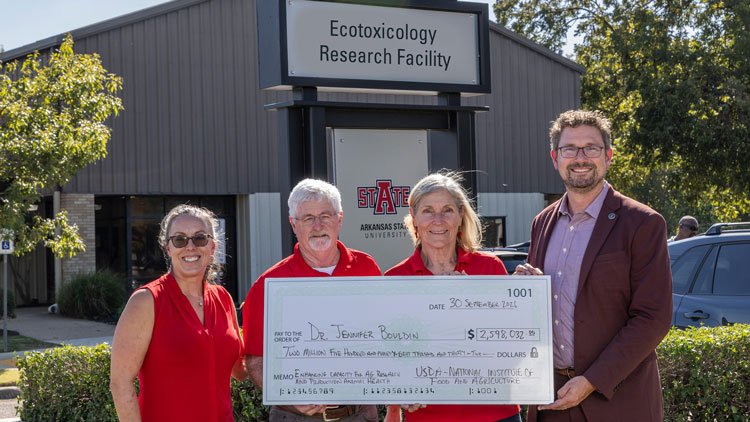
$2.6 Million Grant Awarded to A-State to Research, Improve Animal Health
JONESBORO – Researchers at Arkansas State University aim to advance agricultural research and improve animal health in the Mississippi River Delta region thanks to a $2.6 million project, with $1.3 million from the U.S. Department of Agriculture’s National Institute of Food and Agriculture.
A-State is one of 36 universities nationwide to receive funding through the research facilities program. Given the significant agricultural footprint in northeast Arkansas, the funding will provide diagnostic and analytical capabilities on one campus, expanding research capacity and helping researchers conduct their work more efficiently.
The project began in September and is expected to be completed by 2030. The goals include constructing a space on the university farm to enhance research capabilities for the College of Veterinary Medicine (CVM) and support the animal science curriculum in the College of Agriculture (CoA).
New equipment will also be installed at the Ecotoxicology Research Facility within the Beck College of Sciences and Mathematics to support research into animal feed quality, a major component of large-animal research.
“This grant provides an exciting opportunity for the Beck College of Sciences and Mathematics, the CoA and the CVM to collaborate on innovative research initiatives both within and across the three colleges,” said Dr. Jennifer Bouldin, dean of the Beck College of Sciences and Mathematics at A-State.
Additional animal research will require analytical capabilities for testing organic contaminants, metals and nutrients. Increasing the capabilities in the Ecotoxicology Research Facility will support the research needs of the CoA and CVM while allowing analyses to be conducted on campus, resulting in cost savings for researchers.
The expanded facilities and new equipment will also create more opportunities for students to gain hands-on research experience.
“With expanded facilities and access to new equipment, graduate and undergraduate students across the three colleges will have increased opportunities to engage in innovative research projects, gain hands-on experience, and contribute to discoveries that advance their respective fields,” she added.
Dr. Travis Marsico, vice provost for research, innovation and discovery, says this reiterates the university's focus on improving research facilities and ensuring faculty have the support needed to secure competitive funding.
“The combination of federal investment, university funds, and commitments from donors are critical for growing the research capacity through improved facilities at A-State. I’m so glad to see Dr. Bouldin and her collaborative research team be awarded this grant. She and her collaborators worked very hard under extremely tight deadlines to pull off a quality proposal that looks toward the future of continued research growth. This proposal also received buy-in from our chancellor, provost and vice chancellor for advancement, showing A-State’s commitment to top-notch research facilities," said Marsico.
The health of large-animal herds depends on the quality of the feed they consume. The ability to analyze this food for essential nutrients will give researchers insight into animal health. Having these capabilities on one campus will enhance the rural health of the communities and the products they grow and consume.
“This partnership will expand A-State’s ability to serve the region’s industries, the agricultural community and other stakeholders by fostering collaborative research and addressing real-world challenges. Through these partnerships, A-State can strengthen regional relationships, support economic growth, and develop innovative solutions that benefit the community,” Bouldin added.